Best Dash Cams for Street Parking: Parking Mode Compared
Street parking means your car is exposed around the clock. The right parking mode setting catches the hit-and-run without draining your battery dead by morning.
Disclosure: This article contains affiliate links. If you buy through them we may earn a commission at no extra cost to you.
Street parking is the hardest environment for a dash cam
A car in a private garage rarely needs parking mode. A car parked on the street every night is a different problem entirely — it's exposed to passing traffic, door dings from tight spots, and the classic hit-and-run where someone clips your bumper backing out and drives off. Parking mode exists specifically for this scenario, but not all parking modes work the same way, and picking the wrong one either misses the incident or kills your car battery.
Buffered motion detection vs. low-bitrate continuous recording
No spam. Unsubscribe anytime.
Buffered (motion-triggered) parking mode keeps the camera in a low-power standby state, using a motion or impact sensor to wake the camera a few seconds before the triggering event using a rolling buffer, then records for a set window afterward. This is the battery-friendly option — draw is minimal between triggers — but it depends on the sensor catching genuine motion. A very slow, gentle bump (a shopping cart drifting into your door) can sometimes fall under the sensitivity threshold if it's set conservatively, so tuning sensitivity correctly matters more than the marketing spec sheet suggests.
Low-bitrate continuous parking mode records the entire time the car is parked, just at a reduced frame rate and resolution to conserve storage and power. It catches everything, with no risk of missing a trigger, but it draws power the entire time and burns through your microSD card's write cycles faster. This mode is really only viable with a hardwire kit and a healthy starter battery — running it off a battery pack or the camera's internal battery for a full overnight street park is asking for a dead camera by morning, or worse, a dead car battery if you're pulling straight off the 12V system without a cutoff.
For street parking specifically, most owners are better served by buffered motion detection with sensitivity turned up one notch from default, because you're optimizing for multi-night reliability over guaranteed capture of every micro-event.
Battery drain protection is not optional
Whichever mode you run, you want a hardwire kit with a genuine low-voltage cutoff (see our fuse tap hardwiring guide for the install). Without one, a parking-mode dash cam left running on a car that already sits for days between drives is a slow drain that can leave you needing a jump. Owners consistently report that the cutoff voltage setting matters more than the camera's rated "standby draw" spec, because a slightly-too-permissive cutoff on an aging battery is what actually causes the dead-battery complaints you'll find in reviews.
Picks for street parking
REDTIGER F7NP — buffered motion detection, GPS-timestamped
The F7NP's parking mode uses buffered motion/impact detection and logs GPS data alongside each clip, which is useful for insurance claims since it timestamps and geolocates the exact spot your car was hit.
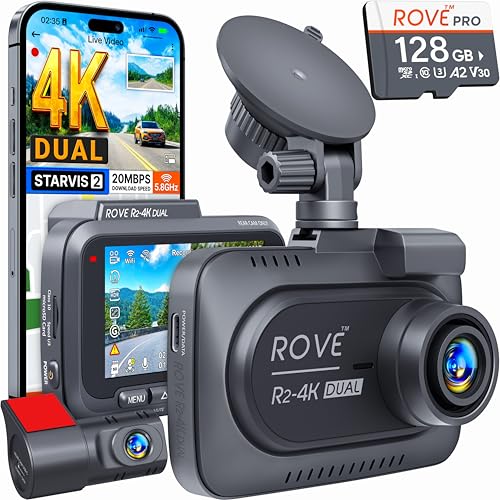
ROVE R2-4K Dual — STARVIS 2 low-light sensor, 128GB included
Overnight street parking means your incident footage is almost always shot in low light. The STARVIS 2 sensor in the ROVE R2-4K Dual is the strongest low-light performer in this lineup, and the included 128GB card gives parking-mode footage room to accumulate over several nights before anything gets overwritten.
70mai M310 Plus — budget front-only with night vision
If you only need front coverage and want to keep cost down, the 70mai M310 Plus includes night vision and basic parking mode support at roughly a third of the price of the dual-channel options above. The tradeoff is no rear camera, so a hit-and-run that clips your rear bumper won't be caught.
Storage capacity and card wear
Parking mode footage, especially in continuous low-bitrate configurations, adds up fast, and it competes with your regular driving clips for storage space on the same microSD card. Cameras that ship with a larger card preinstalled — like the ROVE R2-4K Dual and REDTIGER F7N Touch, both with 128GB included — give you meaningfully more runway before overwriting begins, which matters if you want a few days of parking history available rather than just the most recent overnight. Buyers running a camera without a bundled large card should budget for at least a 128GB high-endurance microSD card rated specifically for continuous dash cam recording, since standard consumer cards wear out faster under the constant write cycles parking mode generates.
Where sensitivity settings actually matter
Most parking mode systems let you adjust motion/impact sensitivity across a handful of levels. Set too high, you'll get false triggers from passing traffic vibration or a gust of wind rocking the car slightly, which fills your card with nothing footage and can obscure the real incident under a pile of junk clips. Set too low, and a slow-speed bump — the kind that actually causes cosmetic damage in a tight parking spot — may not register at all. Start one notch above the factory default and adjust from there based on what your camera actually captures over the first week or two of real-world street parking. If your camera's mount has ever slipped or peeled off the glass, check our mount troubleshooting guide before assuming a hardware failure — heat-related adhesive breakdown is a far more common cause than a defective camera.
The bottom line
For overnight street parking, buffered motion detection paired with a properly configured hardwire cutoff is the setup most drivers should run — it balances battery safety against real capture reliability. Prioritize a camera with a strong low-light sensor like the ROVE R2-4K Dual's STARVIS 2 chip, since nearly every street-parking incident happens in the dark. Budget-conscious drivers who only need front coverage can get adequate protection from the 70mai M310 Plus, but anyone parking on a street with real traffic exposure should run dual-channel front/rear coverage.
Affiliate Disclosure