Best Jump Starters for Diesel Trucks (Powerstroke, Duramax)
Diesel engines have huge compression ratios and cold-start current draw. Here's the peak-amp math for Powerstroke, Duramax, and Cummins trucks, and the jump starters built to match it.
Disclosure: This article contains affiliate links. If you buy through them we may earn a commission at no extra cost to you.
A gas V6 sedan and a 6.7L Power Stroke are not the same jump-start job. Diesel engines run compression ratios roughly double a gasoline engine's, and that compression is what a starter motor has to overcome on every single crank. Add a cold Northern-plains morning and the amp draw needed to turn that engine over climbs fast. This is where a lot of "1000 peak amp" jump packs — perfectly fine for a Corolla — quietly run out of gas on a diesel pickup.
Peak amps by engine size
Manufacturers publish peak-amp ratings as a lab-test ceiling, not a sustained output, so the honest way to shop is to match the rating to your engine class with margin to spare. Owners consistently report that anything marketed at 1000-1200A is a coin flip on a 6.0-7.3L diesel in cold weather, while 2000A-class units start reliably down into the teens and single digits Fahrenheit.
No spam. Unsubscribe anytime.
| Engine class | Typical displacement | Recommended peak amps |
|---|---|---|
| Small gas 4-cyl / hybrid | Up to 2.5L | 400-600A |
| V6 / small V8 gas | 2.5-5.0L | 600-1000A |
| Full-size V8 gas / light truck | 5.0-6.2L | 1000-1500A |
| Light-duty diesel (3.0L inline-6, etc.) | Up to 3.0L | 1200-1500A |
| Heavy-duty diesel (Power Stroke, Duramax, Cummins) | 6.0-6.7L | 2000A+ |
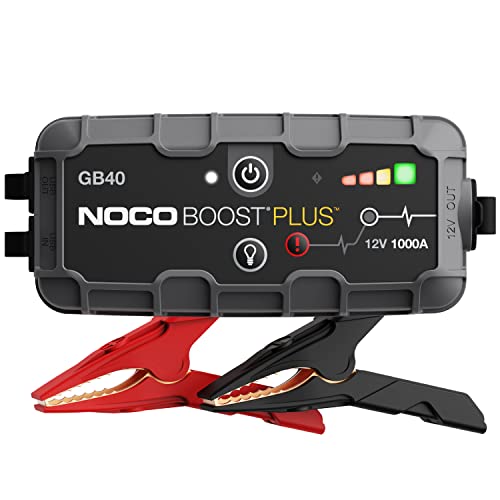
Per the spec sheets, the NOCO Boost GB40 is rated for gas engines up to 6.0L and diesels up to 3.0L — that puts it squarely in "light-duty diesel or smaller" territory, not a 6.7L Cummins. The NOCO Boost GB70, by contrast, is rated to 8.0L gas and 6.0L diesel at 2000 peak amps, which covers the Power Stroke, Duramax, and Cummins family with room left over.
Why 1000A units struggle on 6.7L diesels
The gap isn't marketing spin — it's physics. A 6.7L diesel typically needs a starter motor pulling several hundred amps continuously just to get the crankshaft turning against compression, and that draw spikes hard in the first half-second of cranking. A jump pack rated at 1000 peak amps has very little headroom above that spike, especially once its internal cells are below freezing, since lithium cell output drops in the cold. That's why owners of full-size diesel trucks who bought a compact 1000A unit for "just in case" often report it clicking or under-delivering on the coldest mornings — exactly when they need it most. A 2000A-class unit with diesel-specific certification carries enough margin to still perform when the battery is cold and the compression is fighting back.
Lead-acid still has a place in the shop
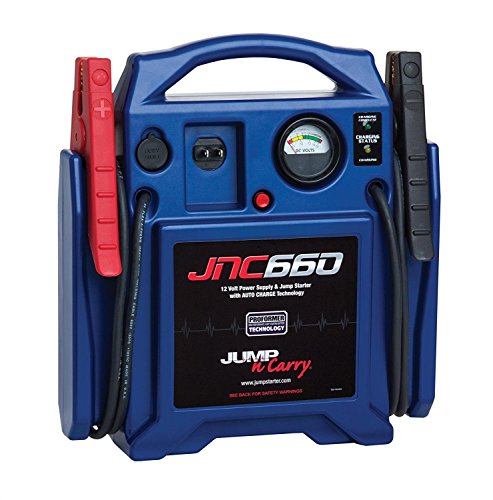
Lithium jump packs win on size and shelf life, but pro shops that jump diesels daily often keep a lead-acid unit on the wall for a reason: sustained output. The Clore Automotive Jump-N-Carry JNC660 is rated at 1700 peak amps and has been a fleet-service staple for years, per widely reported shop use, because its internal battery can deliver current for longer stretches without the thermal throttling some compact lithium packs exhibit under repeated back-to-back starts. It's heavier and needs periodic charging maintenance, which is the trade-off for that sustained-output profile — it's the "keep it plugged in on a shelf" unit, not the glovebox one.
Cold weather changes the math
Diesel owners in cold climates should treat the amp rating on the box as a best-case number. Per NOCO's own documentation, lithium jump starters see reduced output as internal temperature drops, which is exactly why the GB70's 2000A/6.0L-diesel rating is a warm-weather ceiling — expect a real-world safety margin to matter more, not less, once temperatures drop below freezing. That's a strong argument for sizing up rather than buying the minimum-rated unit for your engine.
Reading the spec sheet correctly
Peak amps is only half the label. Manufacturers also publish a maximum-engine-size rating (in liters, for both gas and diesel), and that number matters more than the amp figure alone because it reflects the manufacturer's own testing against real starter-motor loads, not just a lab discharge spike. A unit can advertise a big peak-amp number and still carry a modest engine-size rating if its battery chemistry can't sustain that peak for the full crank cycle a diesel needs. When shopping, check both numbers against your truck's actual displacement — not the "up to" marketing headline — and lean toward the unit whose diesel rating equals or exceeds your engine, not just approaches it.
Cable gauge and clamp quality matter too
A high peak-amp rating is wasted if the jump pack's cables and clamps can't carry that current without heating up or dropping voltage. Diesel-rated units generally ship with heavier-gauge cables and higher-clamping-force jaws specifically because the manufacturer expects them to be used on larger battery terminals and higher current draws. If you're inspecting a jump starter in person, thicker cables and clamps with a firmer spring action are a reasonable proxy for how seriously the manufacturer engineered it for heavy-duty use, on top of whatever the peak-amp number claims.
When a jump starter isn't the fix
If a diesel truck needs jumping more than occasionally, the jump starter isn't the problem — the batteries, alternator, or a parasitic draw likely are. Diesels typically run dual batteries in parallel specifically because of their high cranking-current demand, and a single weak battery in that pair can drag the other down without an obvious symptom beyond slow cranking. Owners who find themselves reaching for a jump pack every cold snap should have the batteries load-tested before assuming a bigger jump starter is the long-term answer; a portable unit is a recovery tool, not a substitute for a healthy charging system.
The bottom line
If you drive a 6.0L-6.7L diesel — Power Stroke, Duramax, or Cummins — the NOCO Boost GB70 is the correctly-sized lithium option at 2000 peak amps and an 8.0L gas/6.0L diesel rating. If your rig is a smaller diesel (think a 3.0L inline-six) or you also daily-drive a gas vehicle, the NOCO Boost GB40 covers that lighter-duty range. Shops or fleets that jump diesels multiple times a day should keep a Clore JNC660 on the bench for sustained-output reliability. For the full amp-rating breakdown across every engine class, see our jump starter amps chart, and if you're deciding between the two NOCO units specifically, our GB40 vs GB70 comparison walks through the decision line by line.
Affiliate Disclosure