How Many Amps Does a Jump Starter Need? (Chart by Engine)
Skip the guesswork: match your engine size to a peak-amp tier in one chart, then see the exact jump starter that fits that tier without paying for capacity you don't need.
Disclosure: This article contains affiliate links. If you buy through them we may earn a commission at no extra cost to you.
Short answer: most sedans and small SUVs need 400-800 peak amps, full-size trucks and V8s need 1000-1500, and 6.0L+ diesels need 2000 or more. The chart below breaks it down by engine class, and each tier maps to a specific unit so you're not stuck guessing which box on the shelf actually covers your vehicle.
The amps-by-engine chart
| Vehicle / engine | Peak amps needed | Fits this unit |
|---|---|---|
| Compact car, 4-cyl, hybrid | 400-600A | Entry-level lithium packs |
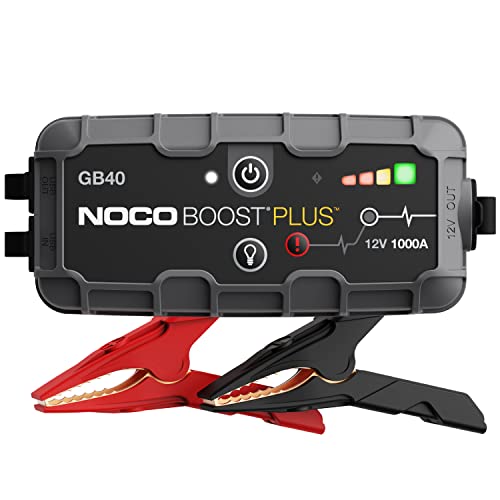
| Midsize sedan, small SUV, V6 | 600-1000A | NOCO Boost GB40 (1000A) |
| Full-size sedan, minivan, small truck | 800-1200A | NOCO Boost GB40 (1000A) |
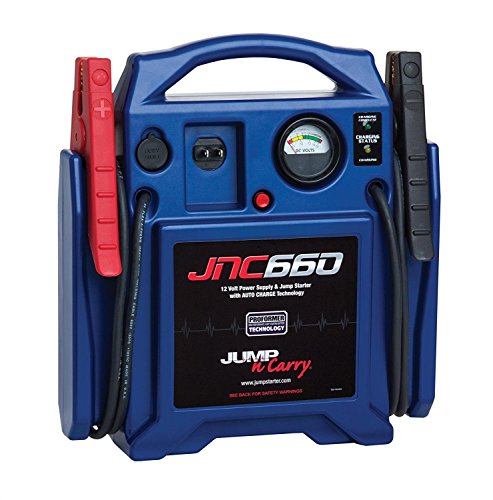
| Full-size truck / large V8 gas | 1200-1700A | Clore JNC660 (1700A) |
| Light diesel (up to 3.0L) | 1200-1500A | NOCO Boost GB40 (rated to 3.0L diesel) |
| Heavy diesel (6.0-6.7L: Power Stroke, Duramax, Cummins) | 2000A+ | NOCO Boost GB70 (2000A) |
No spam. Unsubscribe anytime.
Why "peak amps" is not the whole story
Peak amps describes the maximum current the unit can deliver in a lab-controlled burst, not what it sustains through a full crank cycle in real winter conditions. Per manufacturer documentation, the more reliable number to check alongside peak amps is the engine-size rating in liters — that figure reflects testing against actual starter-motor loads for gas and diesel engines separately. A unit rated 1000A but only "up to 6.0L gas / 3.0L diesel" is telling you plainly that it wasn't validated past that displacement, regardless of how big the amp number on the box looks.
Budget tier: adequate amps without the premium price
If your vehicle sits in the 600-1000A tier, you don't need to spend up for diesel-rated headroom you'll never use. The DBPOWER 3000A and GOOLOO A3 both advertise higher peak-amp numbers at a lower price point than the premium NOCO line, and for a daily-driver sedan or small SUV that's typically enough headroom with margin, per their spec sheets. The GOOLOO A3 adds a 150PSI air compressor in the same housing, which is worth factoring in if you also want inflator coverage — see our full roundup of jump starters under $100 for a side-by-side on this budget tier.
Mid tier: the all-rounder
The NOCO Boost GB40 sits in the sweet spot for most owners: 1000 peak amps, rated to a 6.0L gas engine or a 3.0L diesel. That covers the large majority of cars, crossovers, and half-ton trucks on the road, which is why it shows up across so many "best jump starter" roundups as the default recommendation.
Heavy-duty tier: diesel trucks and fleet use
Once you're into 6.0L+ diesel territory, the NOCO Boost GB70 is the appropriately sized lithium option, rated to 8.0L gas or 6.0L diesel at 2000 peak amps. It also adds a 12V-out port, which matters if you want one device that jumps the truck and runs accessories — more on that combo use case in our guide to jump starters with 12V power-bank ports. For shops that jump vehicles daily and want a unit built for sustained output rather than occasional roadside use, the Clore JNC660 lead-acid unit is the widely reported pro-shop standard at 1700 peak amps.
Cold weather pushes every tier up
Every rating on this chart assumes a reasonably warm battery and moderate ambient temperature. Lithium jump starters lose usable output as their internal temperature drops, so owners in cold climates should treat these tiers as a floor, not a ceiling, and size up one tier if the unit lives in an unheated vehicle through winter. A jump starter that's adequate in October can feel underpowered in January purely from the cold soak, not any change in the vehicle's actual cranking need.
Amps vs. amp-hours: don't confuse the two specs
Peak amps and amp-hours (mAh or Ah on the label) measure different things, and mixing them up is a common shopping mistake. Peak amps is the burst-current capability that actually cranks the engine; amp-hours describes how much total energy the internal battery stores, which determines how many jump attempts you get before recharging and how long the unit can run accessories like its built-in light or a USB charge. A unit can have a large mAh number for long shelf life and phone-charging use while still carrying a modest peak-amp rating unsuitable for a bigger engine — check both numbers separately rather than assuming a bigger number on the box always means a stronger crank.
Multiple jump attempts and recovery time
Per manufacturer documentation, most lithium jump starters are rated for multiple jump-starts on a single charge, but the exact count drops in cold weather and after repeated back-to-back attempts, since the internal cells need brief recovery time between high-current pulls. If a jump attempt doesn't succeed on the first try, owners consistently report better results waiting 30-60 seconds before a second attempt rather than immediately retrying, which lets the pack's internal protection circuitry reset and gives a more honest read on whether the battery or the jump starter is the limiting factor.
The bottom line
Match your engine size to the chart above rather than chasing the highest peak-amp number on the shelf. Most drivers land in the 1000A NOCO GB40 tier; diesel truck owners should jump straight to the 2000A GB70; and budget shoppers who just need occasional backup for a sedan can get adequate coverage from the DBPOWER or GOOLOO units for less money. For a deeper dive on diesel-specific sizing, see our diesel truck jump starter guide.
Affiliate Disclosure